Saudi Arabia Advances Lithium Processing Through New Aramco–NESR Demonstration Project
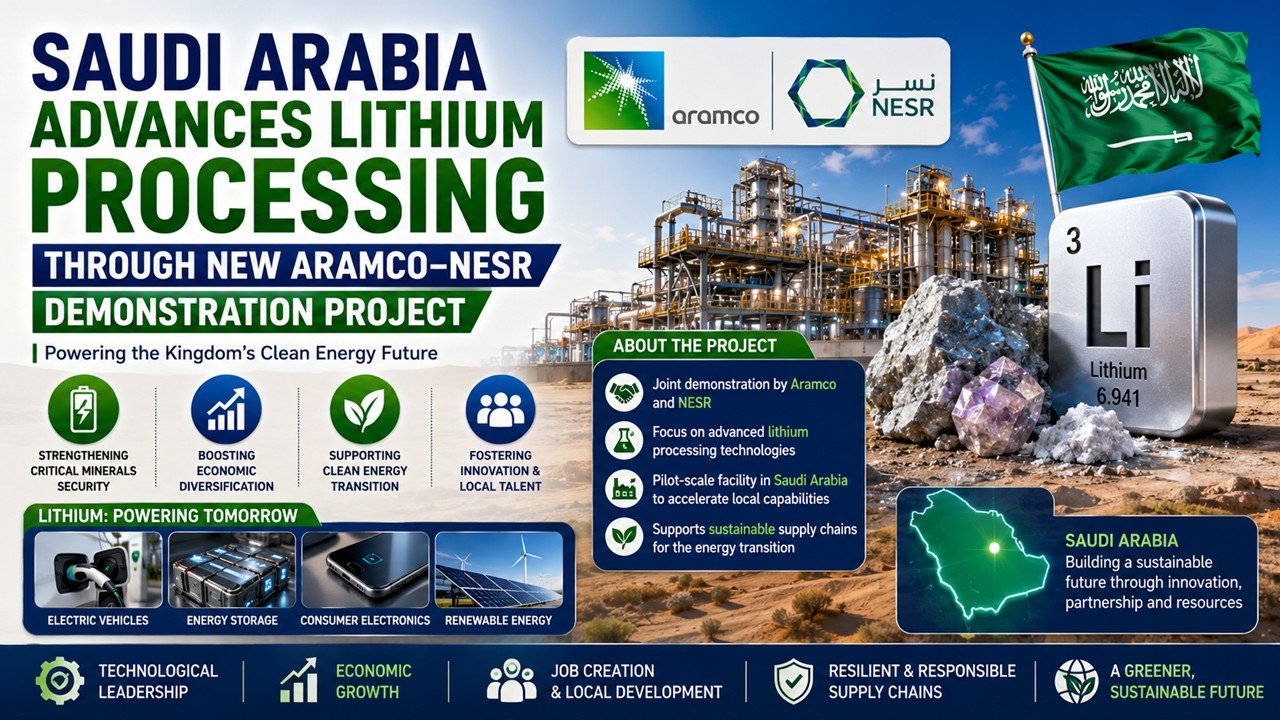
Saudi Arabia has taken a concrete step toward joining the global lithium race. Aramco has signed a deal with oilfield services provider National Energy Services Reunited (NESR) to build a demonstration plant that will turn underground brine into battery-grade lithium carbonate.
NESR announced on October 8 that its environmental arm, NESR Environmental and Decarbonization Applications (NEDA), will carry out the Aramco 2027 Lithium Demonstration Project. It is being billed as the first direct lithium extraction project of its kind in the Kingdom, and in the wider region.
The plant is designed to produce about 2,000 tonnes of lithium carbonate a year, with commissioning and first output scheduled for late 2027. The contract runs up to five years and is worth roughly $200 million.
The partnership pairs two different strengths. Aramco brings decades of experience in exploring and understanding what lies beneath Saudi soil. NEDA supplies the technology: a package of brine pre-treatment, direct lithium extraction and carbonation, all sold under NESR’s LiThara platform.
LiThara’s modular units prepare the brine and pull out the lithium in one integrated process. According to the company, that setup allows quicker, scalable deployment and keeps operating costs competitive. One report noted the scope could stretch to as many as five units. NESR also says the work draws on its existing field and subsurface operations across Saudi Arabia.
The announcement fits a longer-running Saudi effort. Aramco has been studying lithium in its oilfield brines since 2024, when it joined Maaden and startup Lithium Infinity on a commercial pilot after detecting the mineral in brine samples. In 2025, Aramco and Maaden signed a non-binding agreement to form a lithium extraction joint venture by 2027. The country’s Shura Council had also raised the question of sourcing lithium locally back in 2024, pointing to rising demand from electric vehicles.
For NESR, the contract marks a move beyond conventional oilfield work. Analysts see it as an adjacent expansion that could widen the company’s opportunities in its core Middle East and North Africa markets.
For Saudi Arabia, the project is a test of whether a resource sitting in the byproducts of oil production can become a new source of critical minerals. If the demonstration succeeds, it could support the Kingdom’s ambitions in the energy transition and open the way to larger lithium output.