



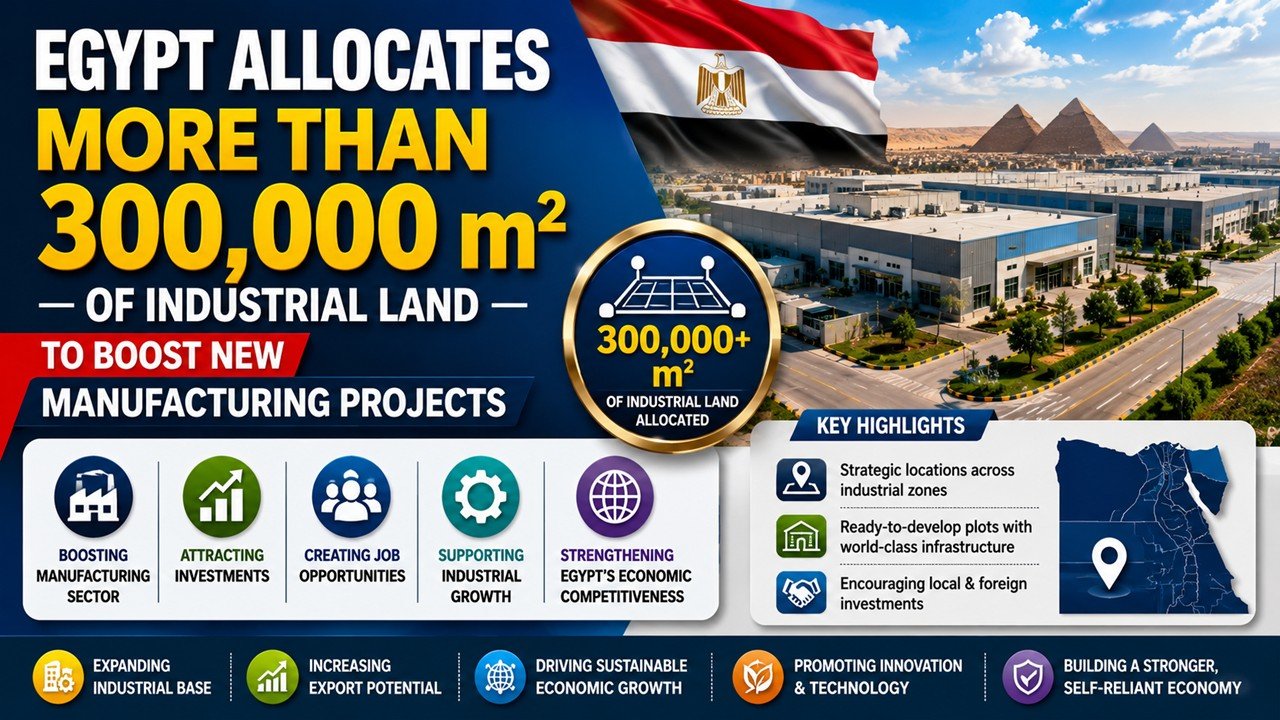
Egypt Allocates More Than 300,000 m² of Industrial Land to Boost New Manufacturing Projects
Egypt has taken a fresh step toward powering its factory floor, with the Industrial Development Authority (IDA) assigning more than 300,000 square metres of serviced industrial land to investors in its debut rent-to-own offering.
The plots are spread across eight industrial zones: New Borg El Arab in Alexandria, Wadi El Natrun in Beheira, Katameya in Cairo, 10th of Ramadan in Sharqeya, New 6th of October in Giza, Sadat in Menoufeya, New Tiba in Luxor and New Akhmim in Sohag.
Investors submitted bids between 15 and 31 August through the Egypt Industrial Hub digital platform. Officials say the strong turnout shows how appealing the new model is, since it lets companies begin with smaller upfront payments and put their cash into construction, machinery and equipment rather than tying it up in land.
The authority also matched each plot to specific industrial activities. The aim is to back local manufacturing, narrow the gap between what Egypt imports and produces, and make projects more financially viable over the long run.
Applicants can follow their status on the platform, while successful ones are being contacted by SMS and email to complete handover paperwork.
There is a catch, however. Winners must deliver their projects within a 24-month schedule counted from the day they receive the land, and the IDA will cancel an allocation and take the land back if any stage is missed.
The move fits a wider drive to make land easier to obtain. A previous quarterly round offered 1,386 serviced plots across 23 governorates, covering 6.8 million square metres, while an exceptional round drew 209 applications and produced 100 allocated plots covering 185,000 square metres across 16 governorates.
Authorities are pursuing a larger goal as well. They want deeper local manufacturing, stronger links to global supply chains, less reliance on imports, and a bigger industrial share of GDP, which they hope to lift from 14 percent to between 20 and 30 percent.
Industry voices say land alone is not enough. A member of the Federation of Egyptian Industries has argued that cheaper financing and energy costs, along with a review of land pricing, are needed so projects can truly take off.