GCC Advances 20 Joint Industrial Investment Opportunities to Strengthen Regional Manufacturing
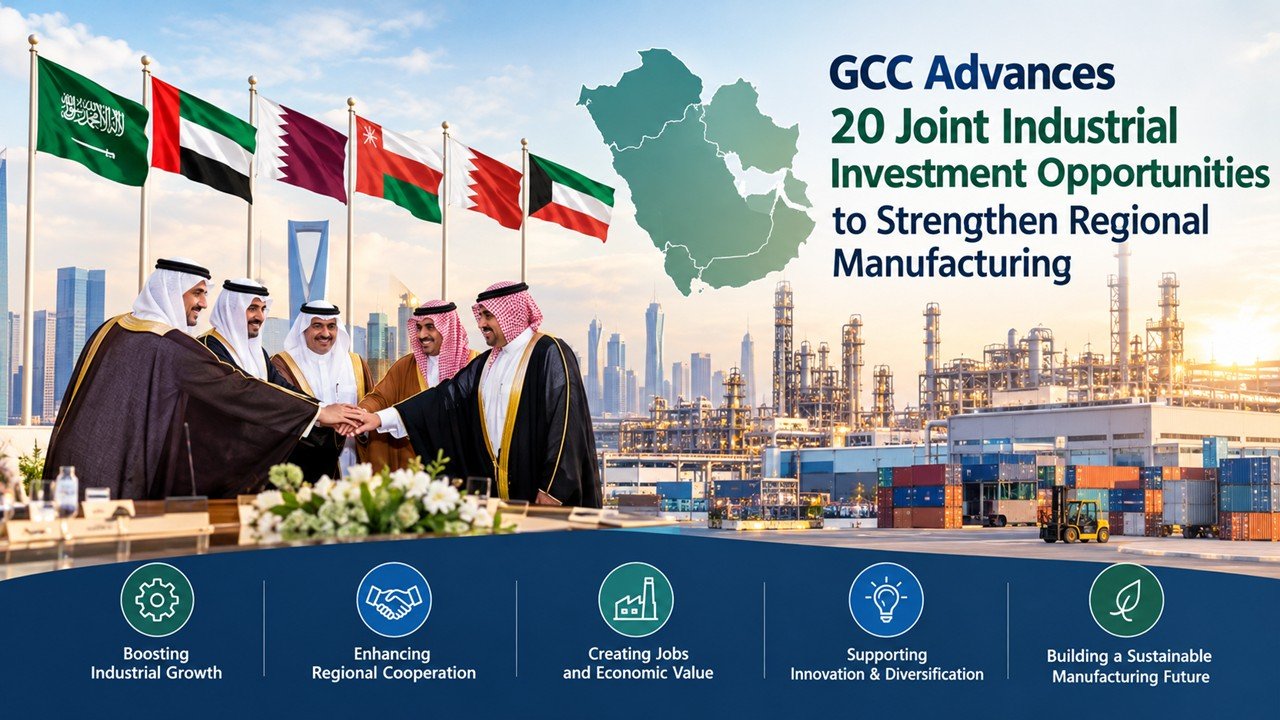
Gulf states are assembling a shared pipeline of industrial projects, with 20 joint investment opportunities now in the works and the first five already cleared for investors. The move is aimed at deepening industrial integration and strengthening supply-chain resilience across the six-member bloc.
GCC Secretary-General Jasem Mohamed Albudaiwi said the opening batch has won approval from the GCC Industrial Cooperation Committee and will serve as a template for ventures that follow. He made the announcement at the Made in GCC 2026 Forum and Exhibition, the first edition of the event, held at Exhibition World Bahrain in Sakhir.
The five approved projects span high-pressure seamless pipes for the oil and gas sector, single-use sterile surgical instruments, high-purity copper cathodes, silicon wafers for semiconductors and multi-parameter patient monitoring devices. They emerged from a screening exercise that began with 26 candidates and was trimmed to 15 before the final selection.
Officials say the larger aim is to curb import dependence, sharpen the competitiveness of Gulf industry and generate quality jobs. Organisers also highlighted the base the bloc already has: more than 22,000 factories and over 1.7 million industrial workers.
Outreach to private investors is already under way. The Oman Chamber of Commerce and Industry recently hosted a promotional workshop alongside the GCC General Secretariat and the Federation of GCC Chambers, putting into action an April decision by industry ministers to endorse the study behind the five projects. Similar sessions are being held in Saudi Arabia to widen participation.
Alongside the forum, the 57th meeting of the Industrial Cooperation Committee in Manama launched the Gulf Centre for the Fourth Industrial Revolution and its digital platform. Albudaiwi stressed that the push rests on years of groundwork, including harmonised industrial legislation, common standards, the GCC Industrial Strategy 2022–2030 and collective protection for Gulf-made goods.
Many details are still missing, however. The sectors, investment sizes and timelines for the remaining 15 opportunities have not been made public. Even so, the momentum signals a clear intent: to knit together Gulf manufacturing strength, capital and supply chains into one regional ecosystem that depends less on the outside world and offers investors a bigger, more connected market.